
Reliable Cooling of Heat Exchangers
Wärmetauscher übernehmen in vielen technischen Anlagen eine zentrale Aufgabe: Sie übertragen Wärme von einem Medium auf ein anderes. In der Kälte- und Klimatechnik, in Wärmepumpen, Rückkühlern, Verflüssigern, Verdampfern, Schaltschrank- und Prozesskühlungen oder auch in industriellen Anlagen sorgt der Wärmetauscher dafür, dass Wärme kontrolliert abgeführt oder nutzbar gemacht wird.
Damit dieser Prozess zuverlässig funktioniert, muss die Luftseite des Wärmetauschers präzise ausgelegt sein. Denn der beste Wärmetauscher kann seine Leistung nur dann vollständig entfalten, wenn er gleichmäßig, bedarfsgerecht und mit ausreichendem Volumenstrom durchströmt wird. Genau hier kommen moderne Ventilatoren, Gebläse und EC-Antriebslösungen von ebm-papst ins Spiel.
Als Lösungsspezialist für Lüftungs-, Kälte- und Gebläsetechnik von ebm-papst unterstützt Breuell & Hilgenfeldt Sie bei der Auswahl und Auslegung geeigneter Komponenten – von der Einzelkomponente bis zur Systemlösung, vom Neubau bis zum Retrofit bestehender Anlagen.
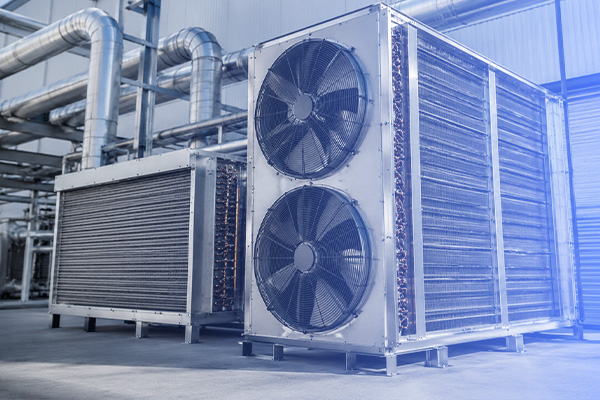
Where are cooled or ventilated heat exchangers used?
Heat exchangers are used in a wide range of applications. Depending on the application, the requirements for airflow, pressure boost, noise level, controllability, protection rating, temperature resistance, and energy efficiency vary significantly.
● Condensers in refrigeration systems
Here, heat from the refrigerant is transferred to the ambient air. Key factors include high airflow, low noise levels, and efficient operation even when outdoor temperatures fluctuate.
● Evaporators and air coolers in cold storage rooms
● Recoolers and dry coolers
● Heat pumps and air conditioners
● Cooling towers and adiabatic cooling systems
● Control cabinets, electronics, and power electronics
● Mechanical and Plant Engineering
Special Requirements for Cooling Heat Exchangers
Cooling heat exchangers involves more than simply moving air. In practice, the interplay of heat exchanger surface area, air flow rate, pressure drop, fan, installation configuration, control system, and environmental factors determines efficiency and operational reliability.
1. Sufficient flow rate
The air flow rate determines how much heat can be removed per unit of time. If the flow rate is too low, the temperature in the system rises. This can result in performance losses, higher condensation temperatures, derating, longer operating times, or a reduced service life of components.
However, it is important to note that more air is not automatically better. An excessively high airflow rate can waste energy, cause noise, and make the system inefficient. The goal, therefore, is to design the system to meet actual needs.
2. Pressure drop across the heat exchanger
Heat exchangers have fins, coils, protective grilles, filters, housings, or air baffles. These components create a pressure drop that the fan must overcome. The closer the fins are together, the dirtier the surface, or the more complex the airflow path, the higher the resistance.
When selecting a fan, therefore, it is important to consider not only the airflow rate but also the actual operating point, which is determined by the airflow rate and pressure increase.
3. Uniform flow
Uneven air distribution reduces the usable heat exchanger surface area. Areas with insufficient airflow can become thermally overloaded, while other areas may be flooded with air. This reduces the efficiency of the entire system.
- Location and Number of Fans
- Distance between the fan and the heat exchanger
- Inflow and Outflow Ratios
- Housing Geometry
- Protective grilles, nozzles, diffusers, and air-handling measures
- Preventing Short-Circuit Currents and Recirculation
4. Energy Efficiency in Full-Load and Part-Load Operation
5. Noise generation
Fans on heat exchangers are often located in sensitive environments: on roofs, on building facades, in industrial areas, in supermarkets, in mechanical rooms, or near workplaces and living areas. For this reason, low noise levels are an important design factor.
Noise is caused not only by the fan itself, but also by unfavorable installation conditions, high flow velocities, vortices, protective grilles, housing edges, or resonance. Selecting the right fan and ensuring proper aerodynamic integration can significantly reduce noise.
6. Outdoor Installation, Moisture, and Corrosion
7. Contamination, Cleaning, and Maintenance
Finned heat exchangers can become contaminated by dust, pollen, grease, leaves, insects, or process particles. This increases pressure drop and impairs heat transfer. The fan solution should therefore be easy to maintain and facilitate simple cleaning.
In applications where hygiene is critical—such as food refrigeration—smooth surfaces, easy access, and designs that are easy to clean are particularly important.
8. Condensation, Ice Formation, and Defrost Cycles
Condensate, frost, and ice can form on evaporators and air coolers. This affects airflow and increases pressure loss. At the same time, goods in the cold storage room must not dry out and should be kept at as uniform a temperature as possible.
The fan solution must therefore be compatible with the defrosting system, the temperature control, and the desired air distribution.
9. Operational Safety and Redundancy
In many applications, the cooling system must not fail. Examples include process plants, data centers, refrigeration systems in the food retail industry, battery storage systems, transformers, and machine cooling systems. In these cases, multiple fans, intelligent control, and condition monitoring can increase availability.
Instead of a single large fan, a solution using several smaller fans may be preferable in certain applications. This improves air distribution and, if necessary, allows the system to continue operating even if a single fan fails.
10. Installation Space and Retrofit Capability
In existing systems, available space is often limited. When replacing old fans, it is important to consider dimensions, mounting points, electrical connections, controls, airflow, and noise levels.
A well-planned retrofit can increase energy efficiency, improve controllability, ensure the availability of replacement parts, and make the system more future-proof—without having to replace the entire heat exchanger.
What types of fans are suitable for heat exchangers?
The right fan solution depends heavily on the application, airflow path, pressure drop, and installation conditions.
Axial fans
Axial fans move air in an axial direction and are particularly well-suited for high airflow rates with relatively low to moderate pressure increases. They are frequently used in condensers, evaporators, recoolers, heat pumps, dry coolers, and cooling towers.
- high flow rate
- compact design
- well-suited for heat exchanger surfaces
- efficient air delivery
- A wide range of sizes and models
- Very low noise levels, depending on the model
Centrifugal fans
Radial fans discharge air radially from the impeller and are particularly suitable when higher pressure losses must be overcome. They are used, for example, in ventilation units, air-handling units, filter systems, duct systems, or compact units with higher flow resistance.
- Suitable for higher pressure drops
- good controllability
- Compact integration into devices
- High efficiency with EC technology
- Suitable for complex air ducting systems
Compact fans
Compact fans are used when heat needs to be dissipated in a specific area within a confined space. Typical applications include electronics, control cabinets, control systems, power electronics, and small heat exchanger units.
- compact design
- precise airflow
- easy integration
- Suitable for cooling equipment and electronics
Blowers
Blowers are suitable for applications in which specific air volumes must be moved against higher resistance. They are used, for example, in process air applications, burner systems, heating technology, and specialized machinery applications.
- Significant pressure increase possible
- defined air supply
- Suitable for specialized system solutions
- versatile
Modern Methods for Efficient Heat Exchanger Cooling
EC technology: tailored to needs, efficient, and adjustable
A major advance in fan technology is EC technology. EC motors are electronically commutated motors with integrated electronics. They combine high efficiency with excellent controllability.
- Continuously variable adjustment of the airflow
- Lower energy consumption during partial-load operation
- less unnecessary air movement
- Lower noise levels at reduced speed
- Integrated protection and monitoring functions
- Easy integration into modern control systems
- greater transparency regarding operating conditions
EC technology can offer significant advantages, especially in systems with highly fluctuating loads. Instead of simply turning fans on and off, their speed can be precisely adjusted based on temperature, pressure, process load, or outdoor temperature.
Speed control instead of on/off operation
A major advance in fan technology is EC technology. EC motors are electronically commutated motors with integrated electronics. They combine high efficiency with excellent controllability.
- Condensing pressure
- Refrigerant temperature
- Fluid Temperature
- Air outlet temperature
- Ambient temperature
- Process or machine load
- Differential pressure at the heat exchanger
Optimized Aerodynamics
It is not just the motor, but also the aerodynamics that determine efficiency and noise levels. The impeller, blade geometry, guide vanes, nozzle, diffuser, guide vane, protective grille, and housing all influence the operating point.
- improve efficiency
- reduce noise levels
- increase the usable flow rate
- Reduce Pressure Losses
- make the flow more uniform
Multiple fans instead of a single solution
For large heat exchanger surfaces, it may be advisable to use multiple fans. This offers several advantages:
- a more uniform flow over the heat exchanger surface
- better controllability at partial load
- greater operational reliability
- Flexible power adjustment
- Lower noise peaks due to reduced rotational speeds
- easier maintenance of individual components
Adiabatic Support
When outdoor temperatures are high, adiabatic pre-cooling can boost the performance of air-cooled systems. In this process, the intake air is cooled by water evaporation before it flows through the heat exchanger.
However, careful planning is essential. Water quality, hygiene, corrosion protection, maintenance, control systems, and environmental conditions must all be taken into account.
Retrofitting Existing Systems
Many existing systems still use older AC fans or unregulated solutions. Retrofitting to modern EC fans may be a good idea if:
- to reduce energy consumption
- the system is too loud
- Spare parts are hard to come by
- to improve controllability
- frequent outages occur
- Statutory efficiency requirements must be taken into account
- the system is to be adapted to new operating conditions
Breuell & Hilgenfeldt assists you in evaluating existing systems and selecting suitable replacement solutions.
ebm-papst Solutions for Heat Exchanger Applications
AxiBlade – High Efficiency and Quiet Operation for Ventilation, HVAC, and Refrigeration Systems
Axial fans with integrated diffuser
AxiCool – Fans for Evaporators and Air Coolers
- even air distribution
- Energy-efficient EC models
- hygienic design
- easy to clean
- High operational reliability in cooling environments
EC medium-pressure axial fans
Radial Fans and FanGrid Solutions
Compact Fans for Electronics and Equipment Cooling
Planning and Design: What Data Is Important?
In order to select the right fan for a heat exchanger, the relevant operating data should be known. The more precisely the requirements are described, the easier it is to find a suitable solution.
- Desired cooling capacity
- Airflow
- Pressure drop across the heat exchanger
- Media and Media Temperatures
- Ambient temperature
- Permissible air outlet temperature
- Installation configuration: suction or pressure
- Available installation depth and mounting points
- Power Supply
- desired arrangement
- Communication Interfaces
- Acoustic Requirements
- Protection Class
- Temperature range
- Moisture and Corrosion Exposure
- Hygiene and Cleaning Requirements
- Operating Hours and Load Profile
- Redundancy Requirements
- Service and Maintenance Guidelines
- Requirements for Spare Parts Availability and Retrofits
Common Mistakes in Heat Exchanger Cooling
When replacing old fans, it is not enough to simply compare their size and connected load. The key factor is whether the new solution is compatible with the overall system in terms of aerodynamics, electrical characteristics, and control technology.
Advantages of a Professionally Designed Heat Exchanger Cooling System
The right fan solution offers several advantages:
- stable temperatures
- greater operational reliability
- improved energy efficiency
- reduced operating costs
- lower noise levels
- longer service life of the components
- better controllability
- less thermal stress
- higher system availability
- Future-proof modernization of existing systems
- better adaptation to new efficiency and environmental requirements
Breuell & Hilgenfeldt: Your Solution Specialist for ebm-papst Fan Solutions
Whether it’s a new construction project, a modernization, a need for replacement parts, or a custom system solution, Breuell & Hilgenfeldt will assist you in selecting the right fans, blowers, and components from ebm-papst.
- technical consulting
- Product Selection
- Design of Appropriate Fan Solutions
- Support for Retrofit Projects
- Custom and System Solutions
- Consulting on EC Technology
- Support for the Replacement and Modernization of Existing Systems
- Solutions for Ventilation, Refrigeration, and Fan Technology
Frequently Asked Questions About Heat Exchanger Cooling
Which fans are best suited for heat exchangers?
Why are EC fans of interest for heat exchangers?
What should you keep in mind when performing a retrofit?
How can noise be reduced?
What causes uneven cooling in the heat exchanger?
When is it worth replacing old AC fans?
Conclusion: The right ventilation system makes the heat exchanger more efficient
Cooling heat exchangers places high demands on the fan, motor, aerodynamics, control system, and installation configuration. What matters most is not just the maximum airflow, but the optimal interaction of all components under actual operating conditions.
With modern fan solutions from ebm-papst, heat exchangers can be operated efficiently, quietly, and tailored to your needs. As a solutions specialist, Breuell & Hilgenfeldt supports you in the selection, design, and modernization of your ventilation, refrigeration, and fan systems.
Are you planning a new system, looking to replace existing fans, or wanting to make your heat exchanger cooling more efficient? Contact us. We’d be happy to advise you and work with you to find the right solution.

